
SECURITY FEATURES
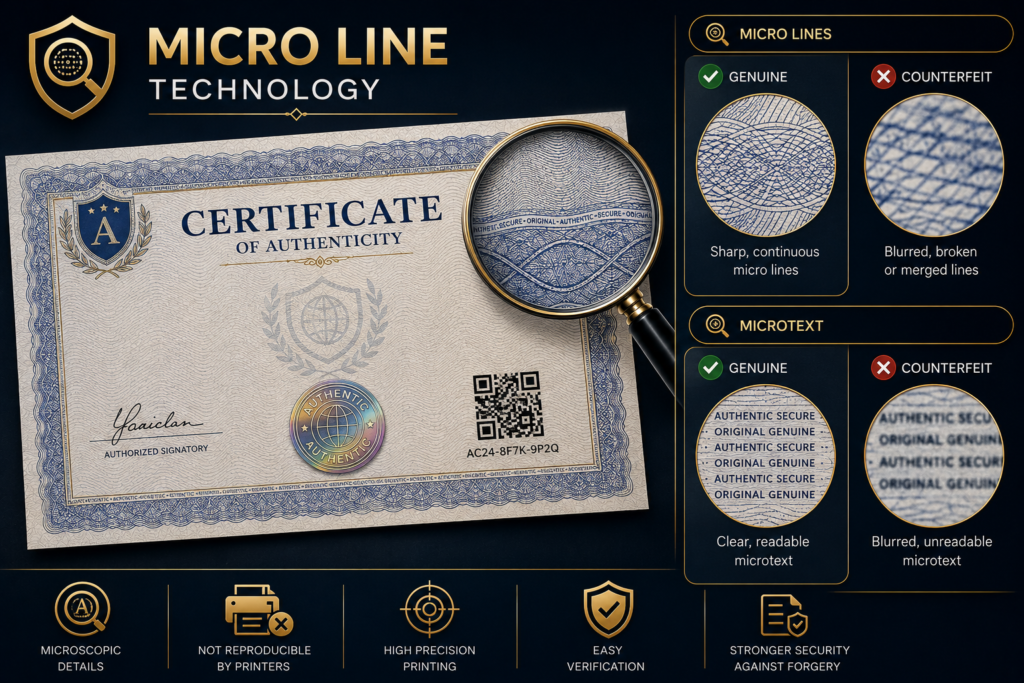
Micro Line Technology
Micro Line Technology uses extremely fine lines and microscopic text integrated into the document design, often invisible to the naked eye and readable only under magnification. These patterns are printed with highprecision equipment that ordinary printers and scanners cannot accurately reproduce.
When counterfeiters attempt to copy the document, the micro lines usually appear blurred, broken, or merged together, immediately exposing the duplication. This makes unauthorized reproduction highly difficult and helps institutions quickly distinguish genuine documents from forged copies.
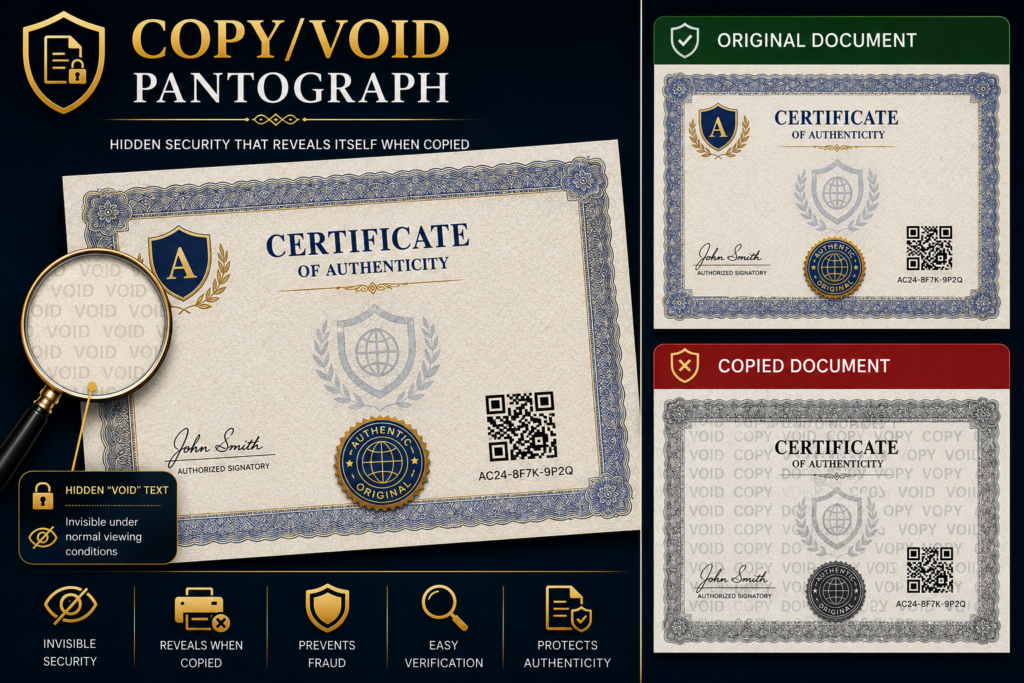
Copy/Void Pantograph
Copy/Void Pantograph technology embeds hidden words such as “VOID” or “COPY” within the document background. Under normal viewing conditions, the text remains invisible, but when the document is photocopied or scanned, the hidden message automatically appears.
This feature acts as an instant anticopying mechanism because any duplicated version visibly reveals that it is not the original document. It discourages fraudulent reproduction and allows verification staff to detect unauthorized copies immediately without requiring specialized equipment.
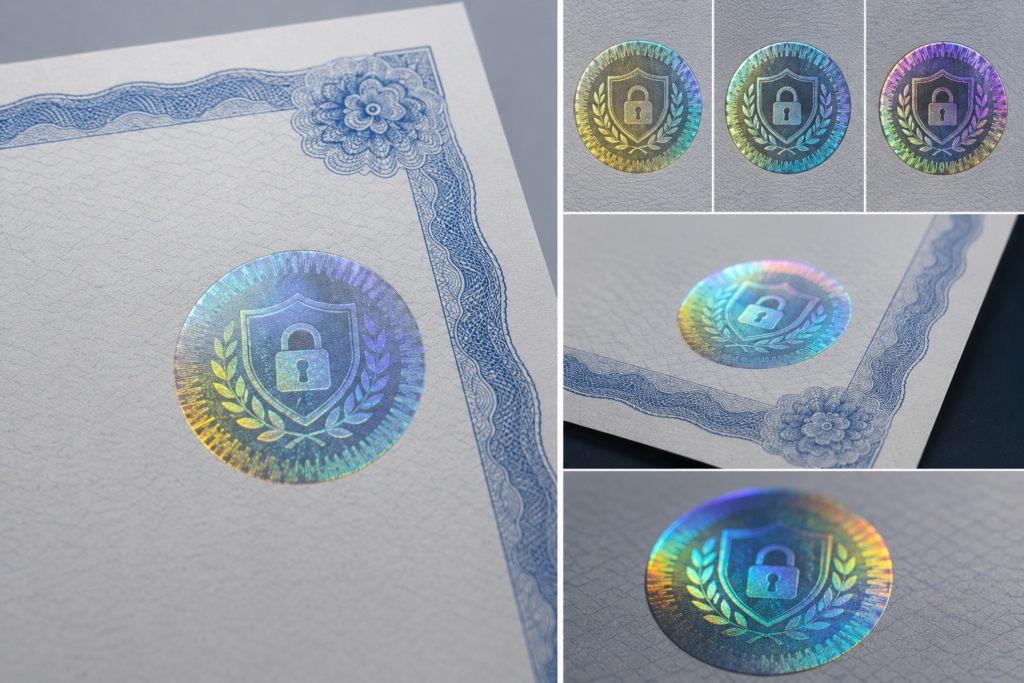
Security Holograms
Security holograms are advanced reflective elements containing multidimensional patterns, logos, and optical effects that change appearance depending on light and viewing angle. These holograms are manufactured using specialized technologies and custom master templates.
Counterfeiters cannot easily recreate the exact reflective behavior, layered imagery, or intricate detailing found in genuine holograms using conventional printing methods. Any attempt to duplicate them usually results in poorquality imitations that are visually distinguishable from authentic originals.
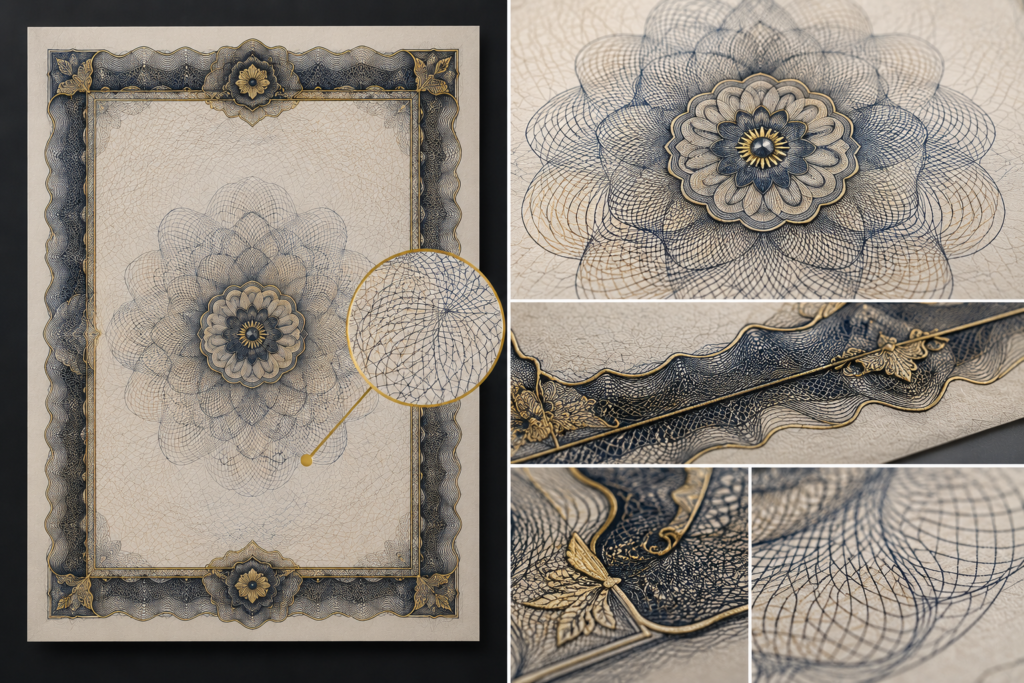
Guilloche Design
Guilloche Design consists of highly detailed geometric patterns made from interwoven fine lines printed with mathematical precision. These designs are commonly used in highsecurity documents because even the smallest distortion becomes noticeable.
When someone attempts to scan, edit, or reproduce the document, the intricate line structures often become distorted, pixelated, or inconsistent. This makes tampering and digital manipulation easier to identify while significantly increasing the complexity of counterfeiting.
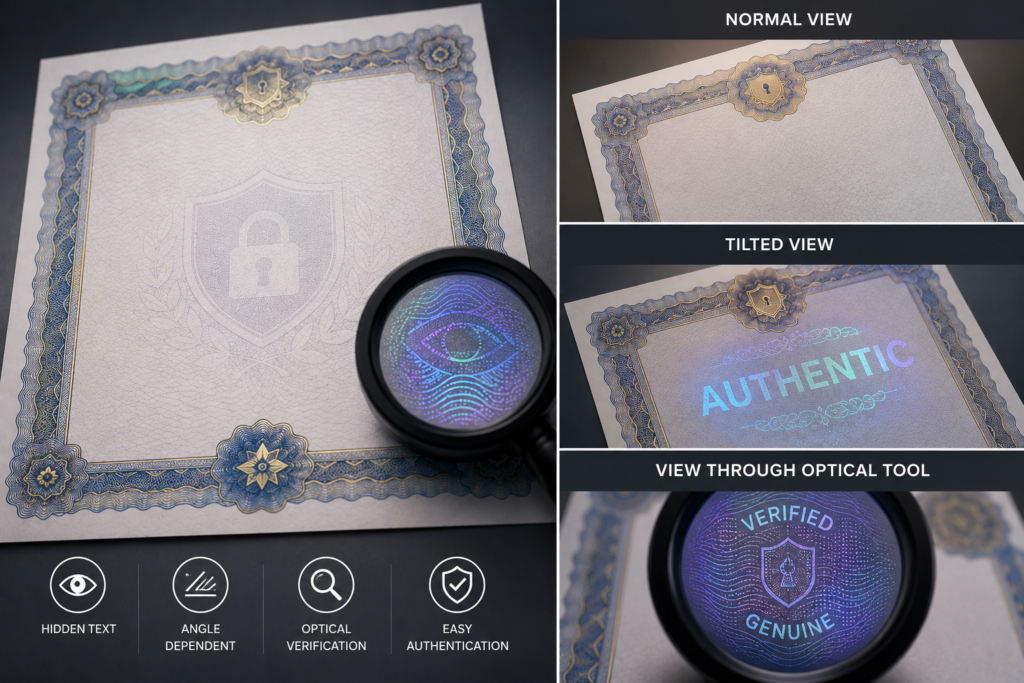
Optical Verifier
Optical verification features contain hidden text, symbols, or design elements that become visible only when viewed at certain angles or through specialized optical tools. These hidden identifiers provide an additional layer of document authentication.
Since these elements rely on precision optical engineering, counterfeiters are usually unable to reproduce the exact visual effects or hidden details accurately. Verification personnel can therefore identify fake documents quickly through simple visual inspection methods.
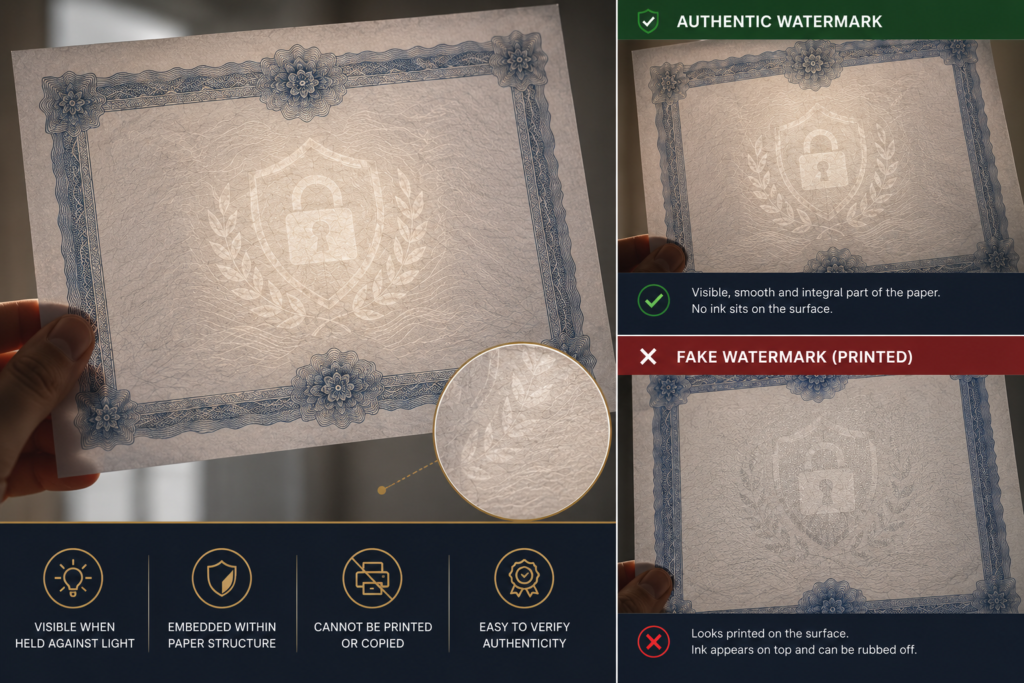
Watermarks
Watermarks are translucent patterns, logos, or symbols embedded directly into the paper during the manufacturing process rather than printed on the surface afterward. They become visible when the document is held against light.
Because watermarks are created within the paper structure itself, ordinary printers and copiers cannot reproduce them authentically. Fake documents often attempt to imitate watermarks through surface printing, which can be easily identified during inspection.
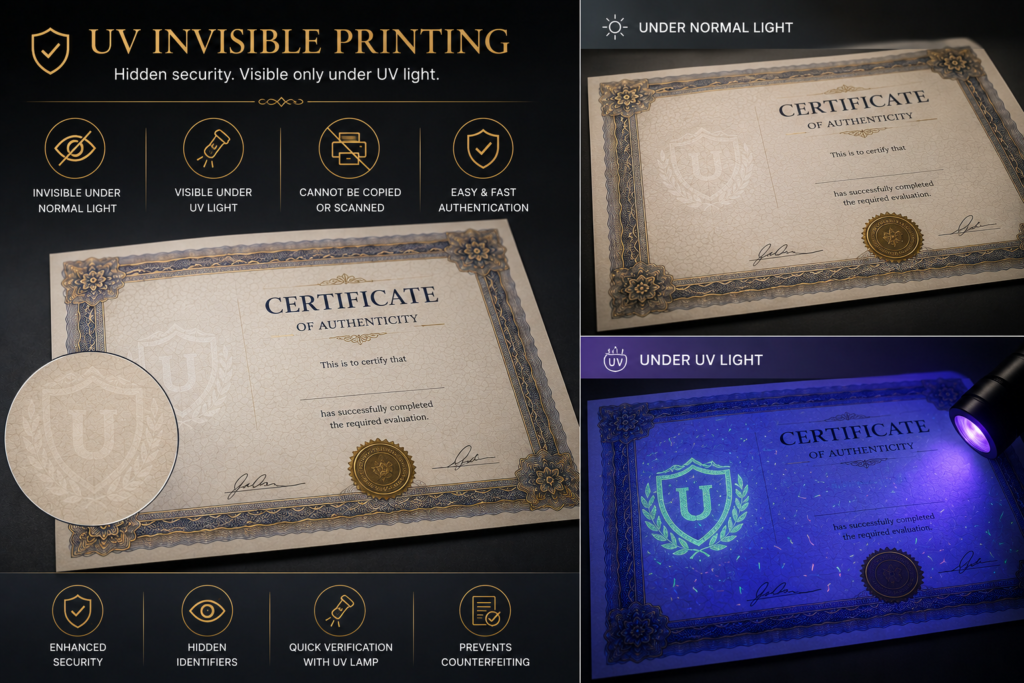
UV Invisible Printing
UV Invisible Printing uses special inks that remain invisible under normal lighting conditions but become visible under ultraviolet (UV) light. Hidden logos, codes, or patterns can be embedded into the document without affecting its visible design.
Since standard photocopiers and scanners cannot detect or replicate UVreactive inks, counterfeit copies usually lack these hidden security markings. This covert authentication layer allows organizations to verify document authenticity quickly using UV lamps.
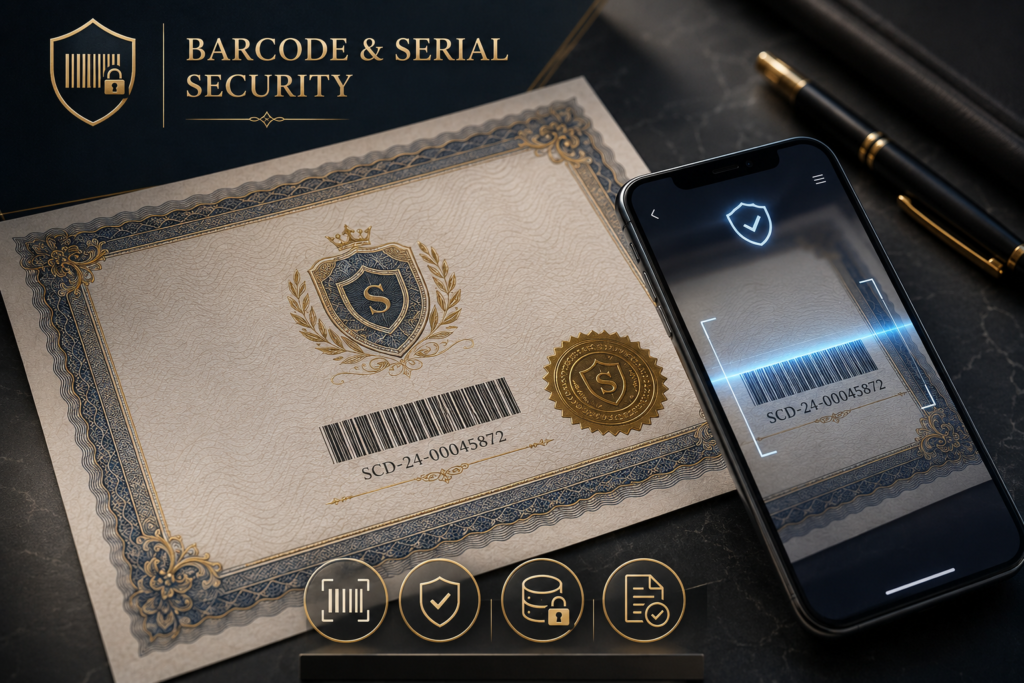
Barcode & Serial Security
Barcode and Serial Security assigns every document a unique identification number or scannable code linked to a secure database or tracking system. This enables realtime authentication, monitoring, and record validation.
Counterfeiters may duplicate the visual appearance of a document, but replicating valid databaselinked codes is significantly more difficult. Duplicate serial numbers, invalid scans, or mismatched records immediately expose fraudulent documents.
MICR Protection
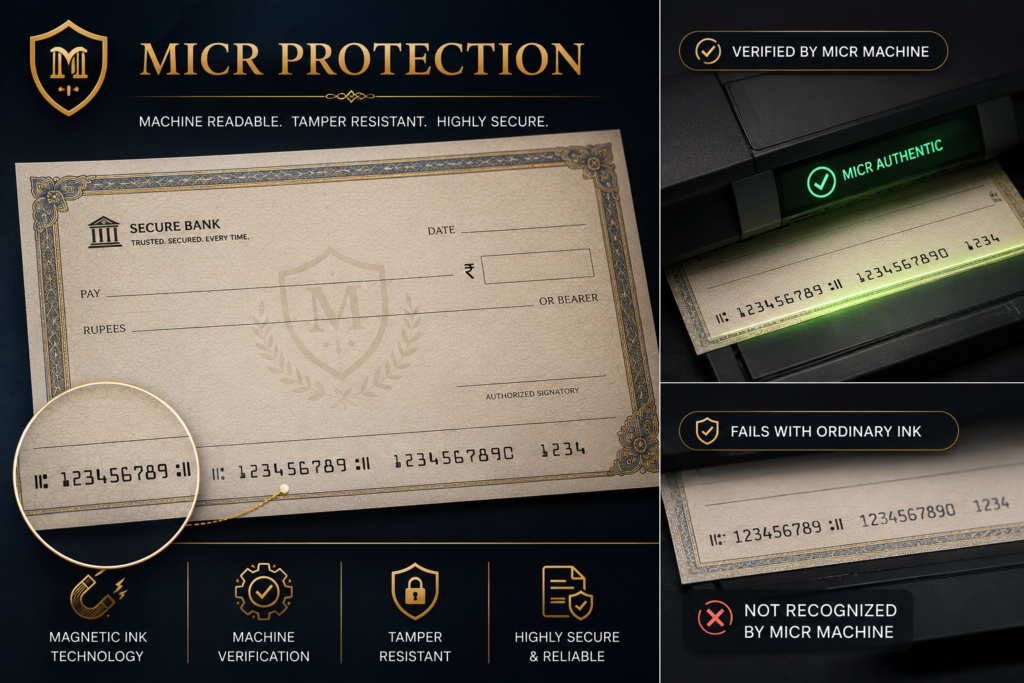
MICR (Magnetic Ink Character Recognition) technology uses specially formulated magnetic ink for printing machinereadable characters, commonly used in financial and highsecurity transactional documents.
Unlike ordinary printing ink, MICR ink contains magnetic properties that can be verified by specialized machines. Counterfeit documents printed using normal ink fail machine authentication, making forgery detection highly reliable and effective
Metallic Foil Features
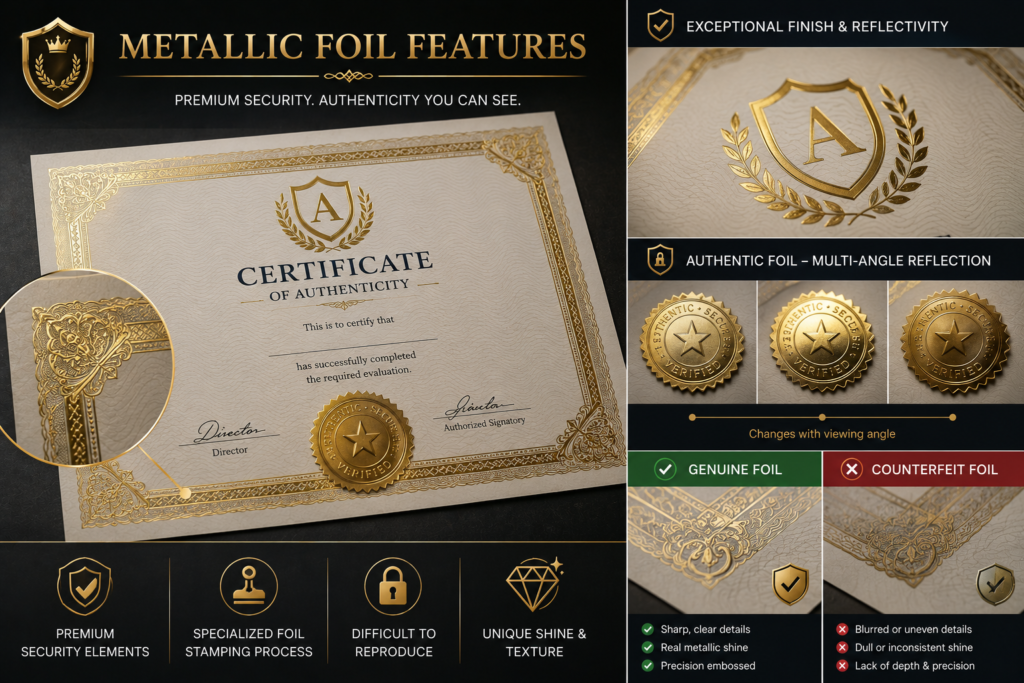
Metallic foil features involve the application of reflective metallic layers through specialized stamping techniques to create premium security elements such as seals, logos, or authentication strips.
These foils are difficult to reproduce because they require dedicated materials, precision equipment, and controlled manufacturing processes. Counterfeit attempts often fail to replicate the exact texture, shine, and reflective behavior of genuine foil applications.
AntiCounterfeit Solutions
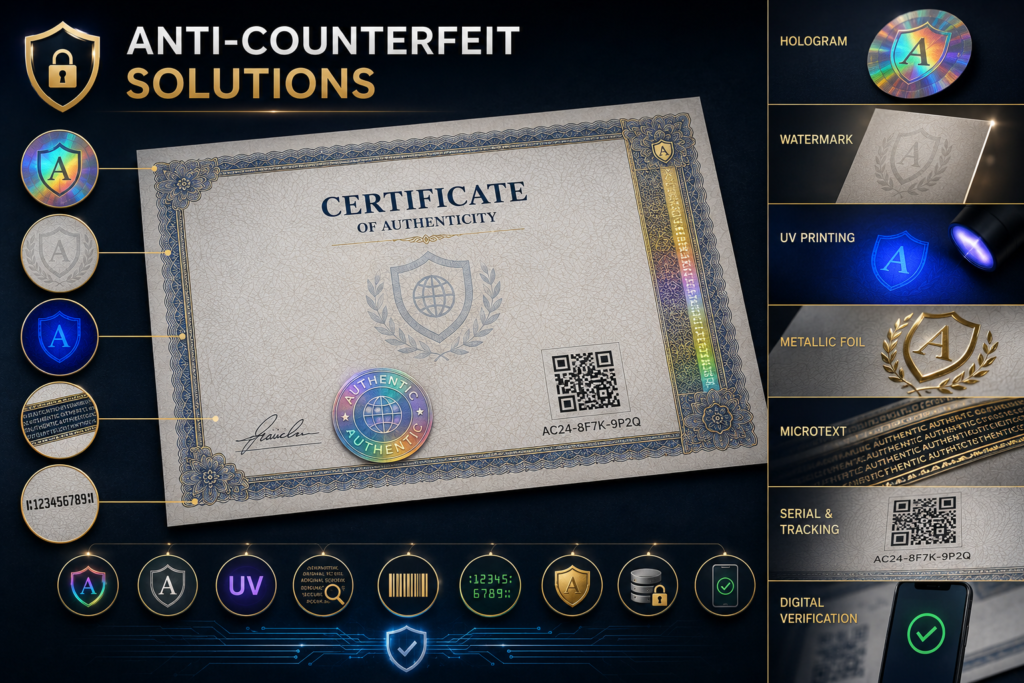
Anticounterfeit solutions combine multiple visible, hidden, digital, and machinereadable security technologies into a comprehensive document protection system. These may include holograms, UV inks, watermarks, serial tracking, microtext, and verification systems working together.
By layering multiple security mechanisms, counterfeiting becomes significantly more expensive, technically challenging, and easier to detect. Even if one feature is imitated, the remaining authentication layers continue to protect the document’s integrity and authenticity.